
Shoulder Labral Tear
What is Anatomy of the Shoulder?
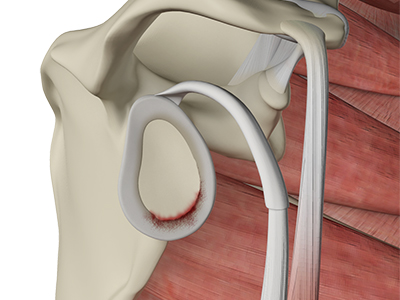
The shoulder joint is a ball and socket joint. A ball at the top of the upper arm bone (humerus) fits neatly into a socket, called the glenoid, which is part of the shoulder blade (scapula). The glenoid is surrounded by a ring of fibrous cartilage called the labrum for stabilization of the shoulder joint. The biceps tendon attaches inside the shoulder joint at the superior labrum of the shoulder joint. It is a long cord-like structure that attaches the biceps muscle to the shoulder and helps to stabilize the joint.
What is a Shoulder Labral Tear?
Traumatic injury to the shoulder or overuse of the shoulder (throwing, weightlifting) may cause the labrum to tear. In addition, aging may weaken the labrum leading to injury.
What are the Symptoms of Shoulder Labral Tear?
Shoulder labral tears may cause symptoms such as:
- Pain
- Catching or locking sensation
- Decreased range of motion
- Joint instability
Robert Najarian, M.D.
Dr. Najarian is board-certified in orthopedic surgery and sports medicine. With additional fellowship training in sports medicine and more than 18 years of experience, he specializes in treating the knee, shoulder, and elbow, as well as all sports-related injuries. His area of focus is in the treatment of knee cartilage and ligamentous injury, shoulder instability and rotator cuff repair, and elbow injuries in the throwing athlete (Tommy John Surgery). He has been named a Washingtonian Top Doctor since 2016.
What are the Treatment Options for Shoulder Labral Tear?
Your doctor may initially suggest conservative approaches such as prescribing anti-inflammatory medications and advise rest to relieve symptoms until diagnostic scans are performed. Rehabilitation exercises may be recommended to strengthen the rotator cuff muscles. If the symptoms do not resolve with these conservative measures, your doctor may recommend arthroscopic surgery.
During arthroscopic surgery, your surgeon examines the labrum and the biceps tendon. If the damage is confined to the labrum without involving the tendon, then the torn flap of the labrum will be removed. In cases where the tendon is also involved or if there is a detachment of the tendon, absorbable wires or sutures will be used to repair and reattach the tendon.
What Does Postoperative Care for Shoulder Labrum Tears Involve?
After the surgery, you will be given a shoulder sling to wear for 3-4 weeks. You will be advised motion and flexibility exercises after the sling is removed. These exercises increase the range of motion and flexibility of the shoulder joint.